
The Most Awful Responsibility: Truman and the Secret Struggle for Control of the Atomic Age
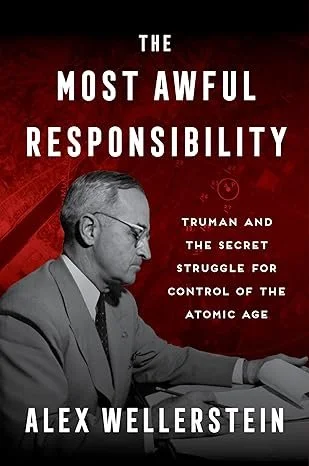
When was the decision actually made to drop the atomic bomb on Japan? History lessons tend to focus on the lead-up and the catastrophic aftermath, but less so on the precise moment, or moments when the decision to unless such unprecedented destruction was made.
In The Most Awful Responsibility, Alex Wellerstein makes a compelling case that there may never have been a single, explicit decision to drop the bomb on Hiroshima in the way we often imagine it. Drawing on extensive research, he suggests that the chain of events leading to the bombing was shaped by a series of incremental decisions, with assumptions made that could easily have lead to misunderstanding on the exact intention of the first bomb and specifically the target. Wellerstein raises the possibility that President Truman may not have fully grasped, at least initially, that the bomb would be used against a densely populated civilian city rather than a strictly military target.
I came across this book after hearing Wellerstein interviewed on Dan Carlins Hardcore History: Addendum, and the discussion was compelling enough for me to pick up the audio book on release. Wellerstein is meticulous in his attention to detail, examining not only the period leading up to the bomb’s development and use, but also the geopolitical events that followed as the world entered the atomic age.
While the book doesn’t and arguably can’t offer definitive answers about Truman’s internal state or intentions at the exact moment the consequences became clear, it does leave you with a far deeper appreciation of how complex, fragmented, and vulnerable decision-making at the highest levels of government can be. With so many moving parts, the potential for miscommunication, misinterpretation, or selective framing becomes not only disturbingly real but even probable.
What lingered with me most from the book was the importance of clarity in communication, authority, and understanding especially when decisions carry irreversible consequences. When devastation on this scale is possible, ambiguity even if by accident and compounded incrementally is both catastrophic and deadly.
The book is broadly split into two halves: the first examining the lead-up to the bombing, the second exploring the aftermath and the beginning of the nuclear arms race. Some readers may find the first section sufficient, but those who want to understand the longer-term implications of entering the atomic era will find the latter half maintains their attention.
Regardless of where readers land on Truman’s responsibility or awareness, it’s difficult to finish the book without reflecting on how critical it is that power, especially destructive power rests with people capable of measured, clear, and accountable decision-making. The reader can be left to ponder on what that means for the state of global political power and world leaders today.
Who’s it for?
This likely won’t appeal to casual readers. Unless you have an interest in political history, military strategy, or World War II, it may not naturally land on your radar. That said, for anyone curious about how one of the most consequential events in modern history unfolded, particularly from a decision-making perspective should find this an informative albeit sobering read. Definitely not light reading, but certainly worthwhile.