
The Illusion of Certainty
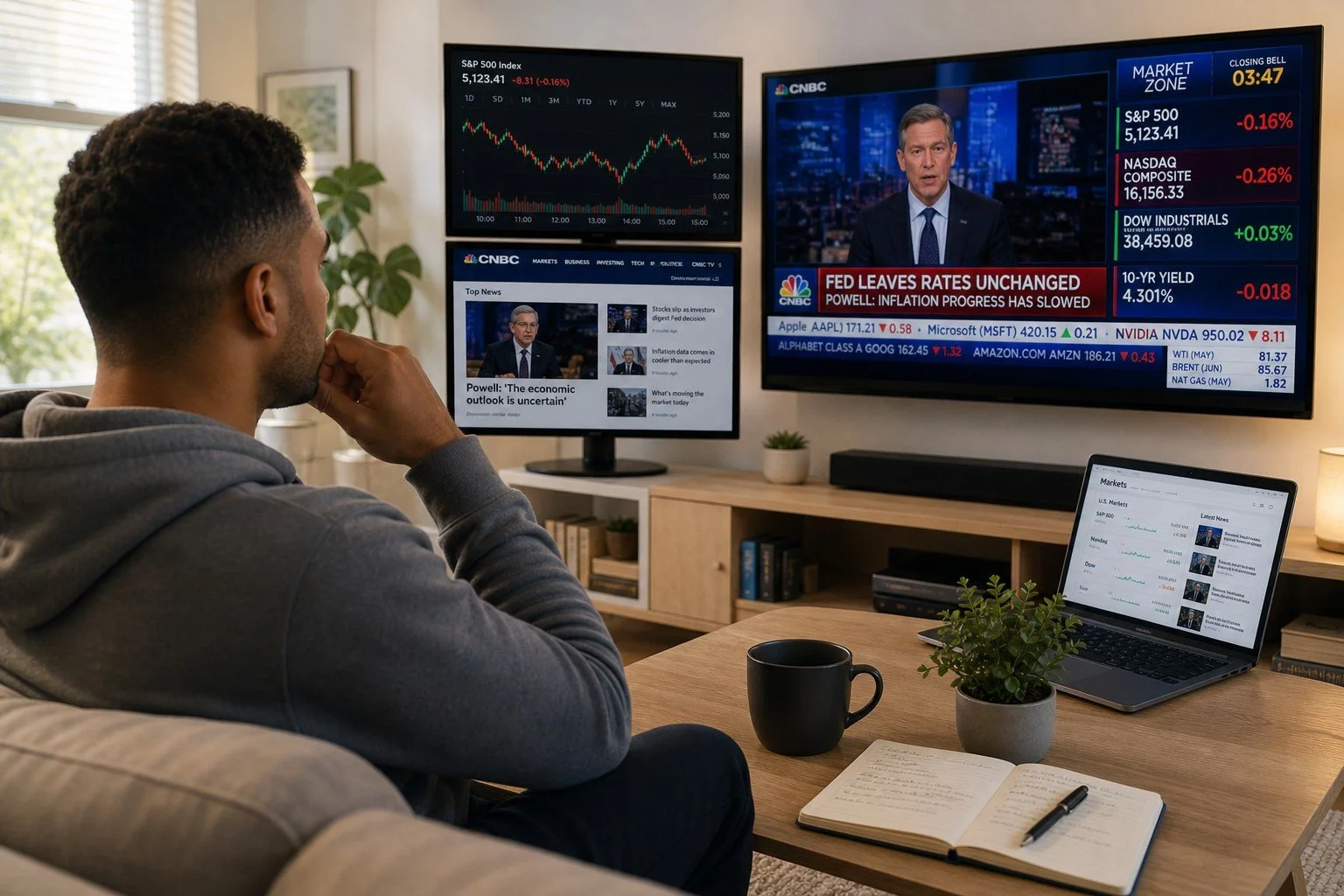
Spend enough time paying attention to the markets and you begin to notice repeatable patterns and behaviours.
On any given day I consume a range of financial and investing content, from news and podcasts through to books.
Whilst I’m not a trader, understanding the different factors affecting the market helps in gathering information, research, and keeping up to date with news related to companies in my portfolio.
What’s become clear is that despite the number of analysts and experts offering their views, they rarely converge on the same reasons for market movements.
The reality is that whilst all these groups may have varying degrees of experience, allowing them to operate with greater confidence in their analysis, no one really knows anything for sure.
The Narrative Machine
You can sense check this for yourself by glancing back over the past few weeks of news and reports. Pick a point in time and you’ll find a wide range of reasons for market movements.
The latest FOMC commentary is interpreted as hawkish or dovish, suggesting a higher or lower probability of rate hikes or cuts, and the market moves accordingly. The latest inflation print or growth estimate is released, followed quickly by an explanation for the rise, fall or stability of the indexes. Companies with a greater weighting on the S&P500, such as the Mag 7, move on results and carry the broader market with them, even though nothing has materially changed for the other 493 companies in the index.
Despite these explanations, the reality is that the market is a complex system made up of millions of participants making decisions that collectively impact prices.
Markets are influenced by a range of factors to varying degrees at different points in time. Fundamentals, sentiment, liquidity and algorithmic flows all interact with human behaviour, fear, greed and overreaction, creating a system that is constantly shifting rather than cleanly predictable.
Commentators and professional investors bring experience, insight and structured thinking, which has value, but it doesn’t make them immune to being wrong. Many will openly acknowledge that they’re wrong more often than they are right, instead focusing on staying in the game long enough for their winners to outweigh their losses.
So What Does This Mean For Us?
You can try to play the game of short-term price movements, trading in and out, reacting to news and interpreting signals. There’s undoubtedly money to be made this way, but for every success story, there are many more that go untold. Traders who bet big, got it wrong and lost everything.
That doesn’t mean you can’t be successful, only that it requires hard work, structure and discipline. Discipline, in particular, is where many struggle once emotions and real financial loss come into play.
Alternatively, you can take a longer-term approach.
You can look past the day-to-day noise, accepting that short-term movements aren’t always explainable, and focus instead on making investments based on a thesis you understand and have conviction in. That doesn’t guarantee success, and it’s often less ‘exciting’ than short-term gains, but it means your decisions are based on a longer-term plan rather than the latest news or interpretation.
Even this approach comes with its challenges. It’s still subject to human emotion, with many investors never realising the benefits of compounding simply because they couldn’t hold positions long enough or endure the drawdowns along the way.
Even if you’re right over the long term, if you get shaken out during periods of volatility, all that remains is the regret of what could have been.
It’s often said that it’s about time in the market, not timing the market, but that, in itself, requires a level of patience and discipline many aren’t willing or able to sustain.
Even The Best Acknowledge Their Limitations
Some of the most renowned investors recognise they aren’t immune to being wrong and acknowledge that their success comes from being right often enough for their winners to outweigh their mistakes.
Warren Buffett and Charlie Munger have both spoken about how a relatively small number of investments accounted for a large proportion of Berkshire Hathaway’s overall returns. It wasn’t about making hundreds of perfectly timed decisions, but about identifying a handful of good opportunities and allowing them to play out over time.
That alone should give pause when considering how much weight is placed on daily commentary and short-term analysis. For all the reading Buffett and Munger did, far more of it was focused on understanding businesses than following daily macro or market news.
The Only True Wisdom…
Socrates famously stated that the only true wisdom is in knowing you know nothing. Whilst he wasn’t referring to investing in markets, the principle is still relevant.
Market commentary, analysis and news aren’t without their value, especially for an informed investor. However, even consuming all the available commentary won’t give you omniscient knowledge of how the markets will move. Information is one thing, sentiment driven by market participants, human emotions and reactions are entirely another.
You could lose a lifetime stressing and trying to figure out every little move or reason for market fluctuations but I suspect you’ll have a hard time enjoying the ride if you do. Instead, it’s worth acknowledging both the limits of your own knowledge but also the ‘experts’.
To quote the famed investor Howard Marks from a piece he wrote back in 2008 ‘Nobody Knows’. Marks is one of the many investors that I regularly tune into and have great respect for. If it’s a good enough thesis for him, it’s a good enough thesis for me.
This article reflects personal views and is intended for informational purposes only. It should not be considered financial advice. Always do your own research or consult a qualified professional before making investment decisions.