
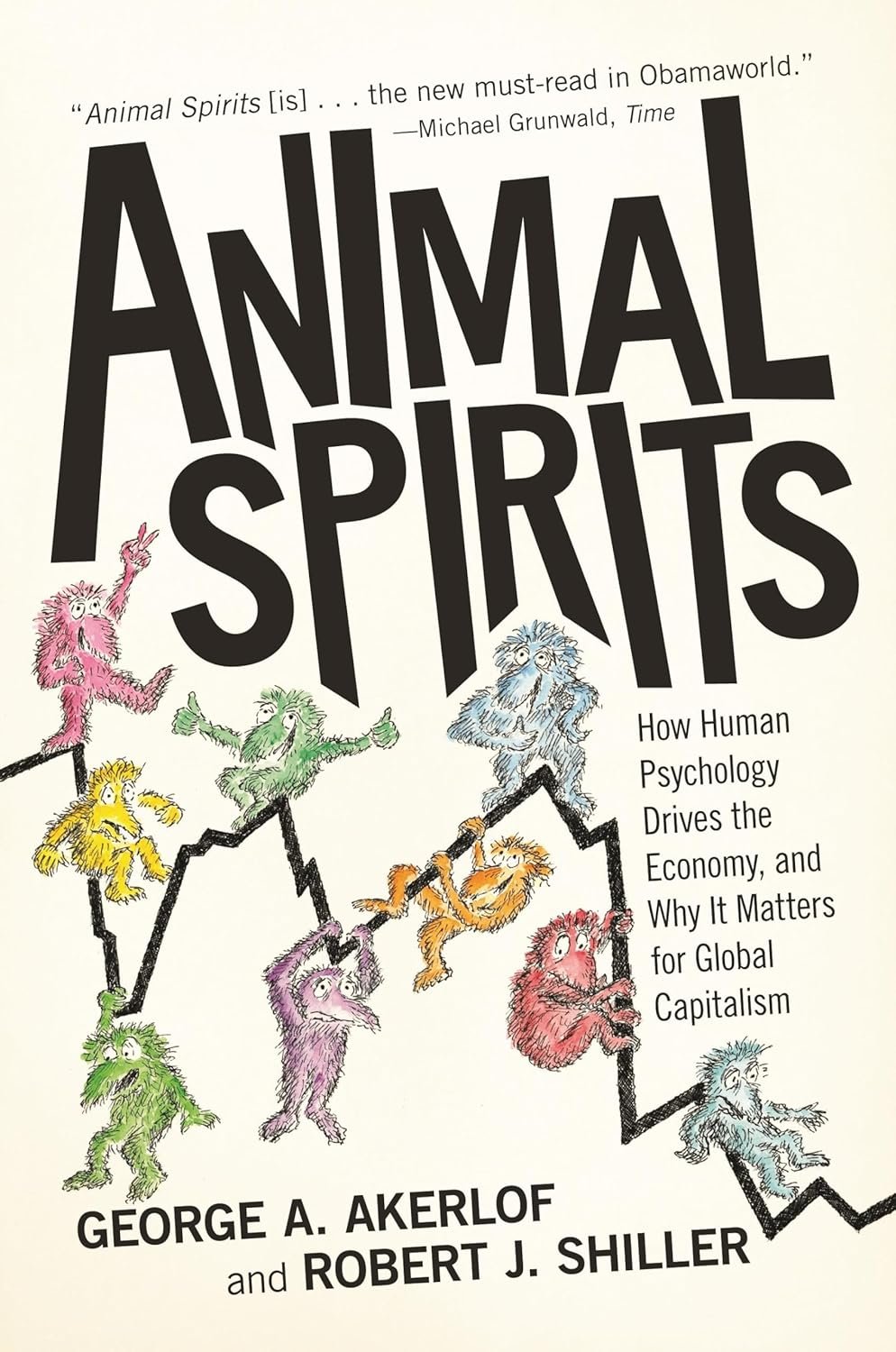
I must admit I came into Animal Spirits expecting the focus to be somewhat narrower and more centred on markets and trading than what it turned out to be. In fairness though I think that’s more due to my bias word association leaning directly to trading when I hear the term "animal spirits”.
What the book actually covers in much broader in scope. Rather than focusing purely on markets, it provides somewhat of a behavioural economics perspective on the wider economy and the role human psychology plays within it. In hindsight, the subtitle makes this clear enough, but it seems my own "animal spirits" overrode those expectations and focused solely on the main title.
The book explores the various forms of animal spirits that influence society and examines how they affect markets, economies and decision making. In doing so, George Akerlof and Robert Shiller draw on a number of economic and financial events that will be familiar to many readers, particularly those over the age of thirty.
Whilst I generally lean towards less government intervention in markets, the authors present a practical and measured argument for why some intervention is necessary. Their case isn't for heavy handed involvement, but rather for maintaining enough oversight and stabilisation to prevent excessive swings in confidence and behaviour from damaging the broader economy.
Naturally, this raises the question of where intervention becomes excessive and begins creating its own problems including setting dangerous precedence. To their credit, Akerlof and Shiller largely avoid descending into political debate though. Instead, they focus their discussion on monetary policy, fiscal responses and the role of central banks in maintaining economic stability.
Though I had picked this up maybe expecting it to lean more towards educating the investor turn trader it’s certainly much more orientated towards the investor turned economist. The breadth of analysis is impressive, particularly in its examination of confidence, fairness, corruption and the power of stories in shaping economic outcomes.
The discussion around money illusion is especially thought provoking from a timing perspective. Whilst the concept itself is relatively straightforward, it was the first time I'd encountered the term formally. Money illusion refers to the tendency for people to think about money in nominal terms rather than adjusting for inflation and purchasing power.
This of course, is particularly relevant for many discussions taking place today. Over recent years, many people have experienced inflation at levels some hadn’t seen in their lifetimes, forcing a shift from thinking about nominal income towards considering what that money can actually buy in real terms.
At 230 pages it’s not an excessively long book and in fact manages to really pack a punch for a book that comparable to many on similar topics is quite conservative in length. It’s even more manageable to get through relatively quickly if you’re a fan of audiobooks instead of reading the physical.
I wouldn't necessarily recommend it as a light summer read, but for anyone with an interest in economics, markets or human behaviour, it earns its place on the bookshelf.
Who's It For?
This probably isn't a book for everyone, but if you're interested in understanding how psychology influences markets and economies, particularly when trying to answer the question of "how did we end up here?", it's a fascinating read.