
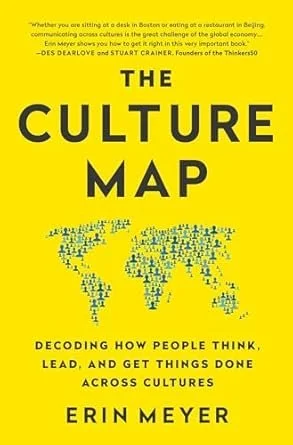
The Culture Map
How late is late enough to warrant a message to the awaiting party? Two minutes? Ten? Fifteen? How did your last performance review really go? Did you excel, or were there areas for improvement? More importantly, are you certain your interpretation is the same as your managers?
Communication underpins nearly every aspect of life, but it becomes especially critical when working across cultures. As soon as you’re exposed to people from different cultural backgrounds, whether professionally or personally, assumptions you didn’t even realise you were making can start to work against you. This is what Erin Meyer sets out to address in The Culture Map, and honestly, I think it should be required reading for anyone operating in a global organisation.
I’ve seen far too many business interactions, projects, and programmes go off the rails not because of what was being said, but because of how it was said, how it was received or both. Misunderstandings can compound quickly, affecting trust, relationships, and morale. Especially in global organisations the issue can stem from a failure to understand cultural norms and adapt communication style, tone, or delivery accordingly.
Some cultures are far more direct than others. Directness doesn’t necessarily signal disagreement or hostility though, it’s simply how clarity and agreement is reached. Meyer does an excellent job of mapping these differences across multiple dimensions, including communication style, feedback, timekeeping, hierarchy, respect, and decision-making. The frameworks she introduces make abstract cultural differences tangible and actionable for the reader.
Most readers will likely experience at least one “aha” moment, realising that a past misunderstanding or awkward exchange was rooted in cultural difference rather than personal friction. Alternatively, the book may reinforce behaviours you already observe, whilst giving you a clearer understanding of why they matter.
I listened to the audiobook but immediately bought the hardback for reference and highlighting. The audio comes with accompanying PDF diagrams so it’s down to your preferred medium really.
Even if you don’t currently work in a global organisation, this is still a hugely valuable read. Whether you plan to in the future, collaborate internationally, or simply want to travel with a better understanding of how people communicate differently around the world, The Culture Map offers insights that will serve you well.
Who’s it for?
Anyone working in a global organisation, especially those in leadership or management roles should read this. It’s equally valuable for people planning to travel or work internationally, as it helps avoid misunderstandings that arise from interpreting behaviour through the wrong cultural lens. Communication is so central to everyday life that it’s genuinely hard to think of many people who wouldn’t benefit from reading this book.