
Choose Your Bubble
Part of my regular routine during daily runs and around the house is listening to financial and investing podcasts, covering everything from the news of the day to topical discussions, debates, research and analysis across the investing and macro landscape.
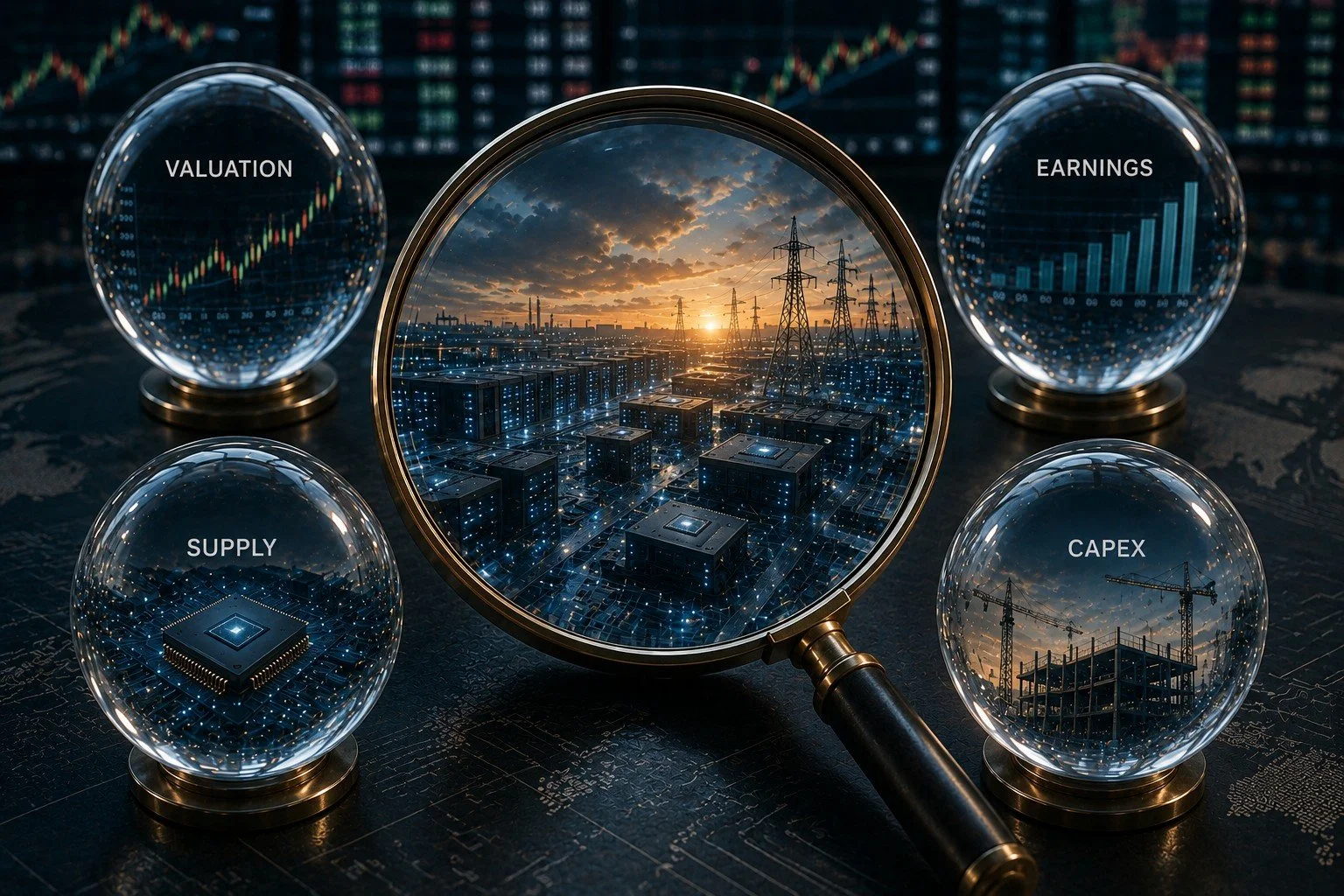
Something that’s become almost inescapable over the past 12 months is the ‘AI Bubble’. Given how much AI and the businesses underpinning it are driving the financial world, the level of attention itself isn’t particularly surprising. What frustrates me, however, is the continual need to distil everything down into ‘we’re in a bubble’ and, if one version of the bubble no longer fits, simply move onto the next.
Initially, it was a bubble in the broadest sense. Valuations had run up enough in a short period, coupled with ‘mematic moves’ by companies making irrational and often unfounded pivots to suddenly becoming an AI company, followed by sharp rises and usually equally sharp falls in their valuations.
Whilst I disagreed with the blunt assessment that AI as a whole was in a bubble, the comparison to the dot-com era was understandable. You didn’t need to look far for examples of irrational exuberance when simply including AI in a company announcement or strategy was enough to get buyers crowding into a short-term speculative trade.
For me though, those examples weren’t sufficient in volume to prove the wider case. The number of obvious AI meme stocks was relatively small compared to the wider market and many of the price surges disappeared almost as quickly as they arrived.
No need to worry though, there was another bubble waiting in the wings.
Time for the valuation bubble!
If the broad AI bubble was difficult to identify, surely it was clear that valuations had become detached from reality?
Maybe, but certainly not obviously so.
Look across a number of high-profile AI beneficiaries in chips, memory, infrastructure and the hyperscalers and, if you removed the preceding 12-month share-price chart and simply assessed the businesses based on current earnings, growth and valuation, a surprising number could still reasonably be argued to sit within a range of fair value.
It seems it was less a case of a valuation bubble and more that the extraordinary journey in the share price changed how we perceive the destination.
A company that has risen dramatically over a year feels expensive because we know where it came from, even where earnings and profitability have moved significantly alongside it.
Rubbish, they’re all overpriced!
Are they though?
The stock market and prices are ultimately determined by the decisions of market participants, not all of which are necessarily rational, so unquestionably some companies will be overpriced. Others may simply have experienced unusually rapid repricing as the market adjusted to equally unusual changes in their earnings outlook and future expectations.
If valuations still aren’t enough to satisfy the bubble thesis, we can simply turn our attention elsewhere.
Let’s look at the eye-watering levels of investment currently being committed to AI infrastructure. Datacentres, chips, networking, power generation and all the physical infrastructure required to support what’s being built. Several major technology companies are taking on increasing levels of debt to fund enormous capex commitments, while some of the relationships between key AI players are becoming increasingly intertwined, with investment, infrastructure commitments and commercial agreements flowing around the same ecosystem.
I think it’s fair and sensible to have legitimate concerns given the scale of the figures and relatively small number of major players involved. A number of commercial arrangements have an increasingly circular feel to them and not every dollar being spent today will produce an acceptable return tomorrow.
This, of course, is exactly the sort of behaviour that’s ripe for pointing at and proclaiming:
“See, it’s a bubble!”
Capex bubble it is then!
That’s three bubbles and counting. Aren’t we just in a wonderfully bubblicious world!
It seems appropriate to steal from a famous expression; it’s bubbles all the way down.
Clearly, I’m being lightly facetious, but hopefully the underlying point is clear. We’re reaching the stage where ‘bubble’ is being used so broadly that I’m not sure how much analytical value the term is providing.
If prices rise quickly, it’s a bubble. If earnings rise enough to support them, surely, they’re unsustainable. If companies invest heavily to build the infrastructure required to support future demand, the spending itself becomes the target of our bubble accusations.
At some point, we surely have to ask whether we’re seeking to reach an informed assessment or simply looking for whichever version of a bubble allows us to keep the original conclusion of ‘it’s an AI bubble’ intact.
Looking Back to Look Forward
I suspect part of the reason it’s so easy to default to ‘it’s a bubble’ is that, in the grand scheme of things, the dot-com bubble wasn’t that long ago. Many of today’s financial commentators were around to experience it during the earlier years of their careers.
The similarities are obvious. Whilst our modern world now operates on the internet, its early years had plenty of ‘Wild West’ elements. Speculation was everywhere, with businesses that had little substance reaching exorbitant valuations. Anything even remotely internet-related added to the froth until the inevitable ‘Pop!’
Just because the bubble popped though, not everything died and went away.
The internet survived and thrived, becoming the foundation for the modern business world. Companies moved beyond their dependency on physical locations, software and services could be distributed globally, commerce expanded far beyond local markets and huge parts of the economy gradually moved into cyberspace.
Whilst the market speculation was real, undeniable and obvious in hindsight, so too was the transformative nature of the underlying technology.
AI, at least for me, appears to hold the potential to reach even further into how we work, create and innovate.
The internet provided an environment in which businesses and people could operate more efficiently and over far greater distances. AI increasingly provides the ability to automate parts of the work being done within that environment and scale forms of cognitive work that previously depended almost entirely on human effort.
Software development, research, data analysis, product creation, scientific discovery, medical advances and countless other areas potentially benefit from increasing our ability to produce and innovate without being constrained solely by the amount of human cognitive labour available.
Two transformative technologies, but one that may reach into far more areas of our lives, society and the world, with potential benefits that are still incredibly difficult to comprehend.
Taking us full circle back to the financial element, none of this potential means every company operating within the AI ecosystem has a justified valuation, that every investment is sensible or will pay off, nor that there won’t be flash-in-the-pan, smoke-and-mirrors companies appearing along the way.
It does mean, though, that we should be careful about judging the eventual returns from a transformational technology purely against what it’s producing today or what we expect it to produce over the next twelve months.
Our Impatience with Progress
The timelines at play are particularly relevant because of the scale of change AI could bring and the physical and virtual foundations required to support it.
Far too many times over the past couple of years I’ve heard the argument that AI is a fad or that it’s already failed to deliver on its promise.
“It’s not that smart.”
“It makes mistakes.”
“I tried it and couldn’t get much out of it.”
“Where are all the productivity gains?”
Whilst these assessments may be accurate today for a subset of available AI capabilities, they completely overlook how remarkably early we still are in this transformation.
Most organisations haven’t come close to properly embedding AI into the way they operate. From my own experience working within the IT sector, businesses are still dealing with the foundations: data quality, security, governance, architecture, skills and identifying where the technology can genuinely improve how work gets done.
There’s a considerable difference between giving employees access to ChatGPT, Claude or Gemini versus redesigning an organisation with AI capabilities embedded at the core.
The latter takes time.
Not only does it take time but, if you haven’t worked within IT, whatever you think it might take, take that and at least double it.
Before we even get to the organisational scaling challenge, there are physical constraints at the core of building out AI infrastructure. AI capabilities and demand can advance rapidly, but data centres, power generation, semiconductor fabrication and grid infrastructure can’t simply be spun up overnight.
Infrastructure decisions have to be made years ahead of knowing exactly what eventual demand will look like.
The spending happens today while much of the expected return sits somewhere in the future.
It’s fair to say that the current level of investment is nothing short of astonishing and, more than likely, some of it will prove excessive.
It’s also entirely possible though that spending which looks excessive against today’s utilisation starts to look like prudent and rational planning if AI adoption continues at pace and increasingly utilises that infrastructure as it comes online.
If you’ve spent any time in the technology or investing world, the idea that humans struggle with exponentials won’t be new to you. We instinctively extrapolate from what we can see today and struggle to comprehend what happens when capabilities compound over time.
That may prove particularly important when it comes to AI.
The Limits of What We Know
Another thing we as humans struggle with is uncertainty.
The financial world has an even more difficult relationship with it because uncertain or not, decisions still have to be made. Commentators need to commentate and analysts need forecasts. Investment managers need views and financial media needs something more useful than an hour-long discussion ending with “We don’t really know yet.”
I completely understand that, however, the problem comes when expertise in one area begins to imply expertise in another.
Someone can be exceptional at analysing financial statements, capital allocation and valuations without necessarily understanding the technical development of AI, semiconductor roadmaps, memory markets or the realities of enterprise technology adoption.
Equally, someone working deeply within technology doesn’t automatically know what multiple investors should pay for Nvidia or where the S&P 500 trades next year.
And yet, we regularly hear confident predictions on exactly how AI development will play out, which LLM provider will ultimately win, what comes next for Nvidia or whether the historical cyclicality of memory must inevitably repeat in exactly the same way as before.
Too often the analysis eventually falls back on finding a comparable historical period and reassuring ourselves that ‘this time isn’t different’.
Yes, things don’t always repeat, but they often rhyme, especially if you zoom out far enough.
However, is finding the closest historical analogy really enough to form the basis of critical analysis for something that may be fundamentally different in both capability and scale?
I suspect the bubble discussion will continue for several more years.
All the while, the doers, innovators and creators will continue advancing AI capabilities. Infrastructure will continue being built. Organisations will continue improving their data and technology foundations and gradually embedding AI deeper into the way they operate.
There will almost certainly be periods of genuine irrational exuberance along the way. Bubbles will probably form and burst in individual companies, sectors and perhaps eventually across much broader parts of the AI market.
I’ve no claim to knowing exactly what the future holds and little interest in pretending otherwise.
What I do know is that I’m far more interested in seeing what the technology ultimately allows us to create, produce and discover than determining who was closest to the pin when calling the next bubble.
Nothing in this article should be construed as financial or investment advice. It represents my personal views and reflections only. You should conduct your own research and consider your individual circumstances before making any investment decisions.