
Biological War: A Scenario
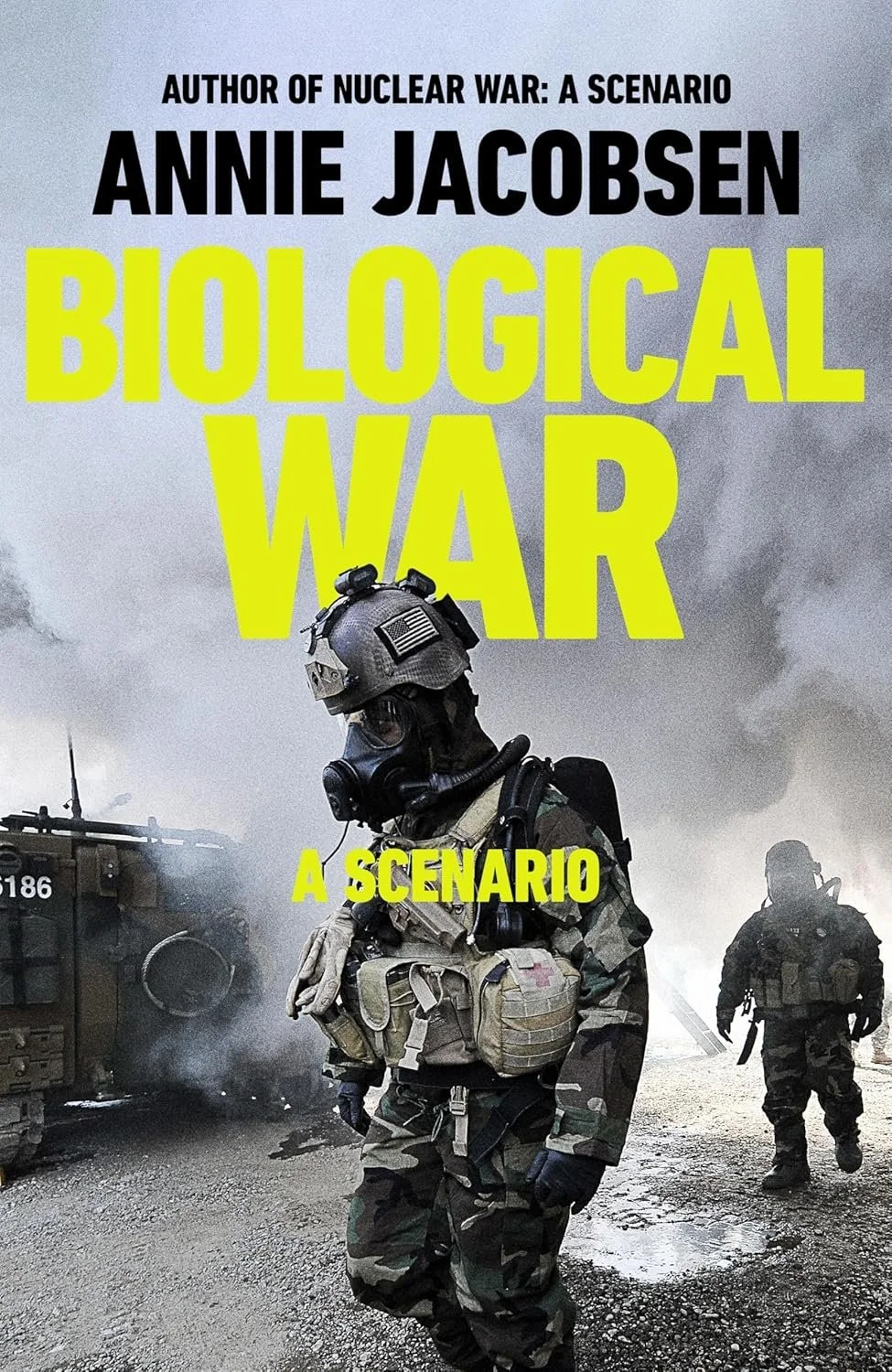
I’m generally of the opinion that information should be free for all. Reading Biological War: A Scenario, however, did give me reason to pause and reflect on this though, not necessarily on the material but on the seeds that it may plant in the wrong minds.
In an age where AI makes it increasingly easy to explore new ideas, scientific concepts and technical information, there are moments when you’re left feeling slightly unsettled as you go through the book.
Much like her earlier book, Nuclear War, Jacobsen constructs a hypothetical scenario that follows a plausible chain of events from an initial incident through to its most catastrophic conclusion. Whilst fictional in structure, the narrative is grounded in extensive interviews with experts and officials, giving the scenario a degree of realism that makes it difficult to dismiss entirely.
It's easy to read the book and question elements of the scenario. Would events really unfold exactly as described? Could a disease spread from Siberia to across the United States in such a short timeframe? Reasonable challenges to make on the premise but it doesn’t allow you to escape from the broader point being made.
Unlike historical pandemics that spread at the speed of ships, modern infectious diseases travel at the speed of aircraft. In an interconnected world, geographical distance offers remarkably little protection once an outbreak begins.
Jacobsen takes time at the end to explain the book isn't intended to frighten readers but rather to highlight the importance of preparedness, governance and effective countermeasures. I suspect she's well aware that, for many readers, it will achieve both.
The scenario itself centres on the accidental release of an engineered biological weapon from a laboratory in Russia. The pathogen is presented as a chimera, combining characteristics of multiple diseases into a single organism. According to the scenario, it initially produces feelings of euphoria before rapidly progressing into plague-like symptoms with a 100% fatality rate unless treated early with antibiotics that are in short supply.
Highly improbable? Perhaps.
Impossible? That's a far more difficult question to answer.
We already know that labs around the world store dangerous pathogens under strict security and governance. The book asks readers to consider what the consequences might be if those safeguards were ever to fail, whether through accident or something more deliberate.
Jacobsen deliberately follows one of the darkest plausible paths, tracing how such an outbreak could move through densely populated areas of the United States. Whilst the narrative focuses primarily on America, it's impossible not to consider the wider implications for an interconnected world.
It actually reminded me of the closing sequence from Planet of the Apes, where global flight paths illustrate how quickly a virus could spread across continents. The visual comparison fits almost perfectly with what’s outlined in the book and will no doubt be included in a TV depiction to follow at some point.
Equal parts fascinating, unsettling and thought-provoking, Biological War leaves readers contemplating just how vulnerable modern society remains to biological threats. Whether every element of the scenario proves realistic is almost secondary to the larger questions it raises about preparedness, biosecurity and the responsibilities that accompany increasingly powerful scientific capabilities.
If you're looking for a light, relaxing read, this probably isn't it.
If, however, you're interested in exploring what a large-scale biological outbreak might look like and the challenges it could present, it's difficult to finish the book without having plenty to ponder.
Who's It For?
Despite the seriousness of the subject matter, the book is written in a very accessible style. No prior knowledge of biology, medicine or geopolitics is required.
Whenever specialist concepts or historical events become important, Jacobson pauses to provide enough background for the reader to follow along without becoming overwhelmed.
If you enjoyed Nuclear War, you'll almost certainly enjoy this as well.