
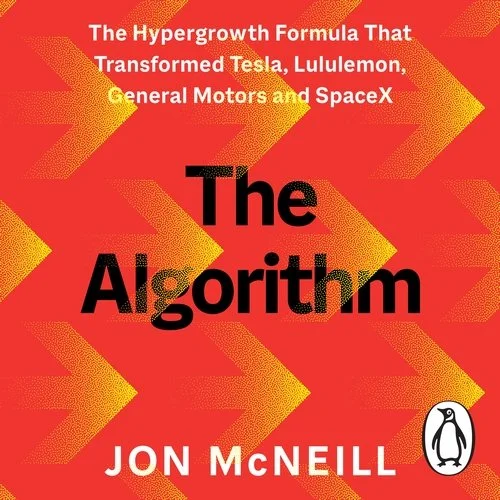
Prior to listening to Jon McNeill’s The Algorithm, I was already familiar with its core principles from hearing Elon Musk refer to them during various podcast interviews. That’s probably why, despite the book appearing in my recommendations for a while now, I hadn’t prioritised reading it. Given its relatively short length, I wasn’t convinced how much additional value I’d get beyond what I’d already picked up from those discussions.
Having finally purchased the audiobook though, I was happy to be proven wrong.
Whilst not a particularly long read or listen, the book follows along the same lines as the algorithm itself from a simplicity perspective, mostly avoiding any unnecessary filler.
So, what actually is the Algorithm?
It consists of five steps: question every requirement, delete anything unnecessary, simplify and optimise, accelerate cycle times and, only once you’ve done all of that, automate.
Simple in principle, considerably harder in practice!
Anyone who has spent time working within organisations of almost any scale will recognise how difficult implementing even one of those steps can be, let alone consistently applying all five.
McNeill works through each step of the process chapter by chapter, using examples to demonstrate both the simplicity and power of the Algorithm when applied effectively. From his time in and around Tesla through to examples involving Lululemon and even a particularly novel restaurant experience, the case studies help move the ideas from abstract principles into practical application for the reader.
That’s ultimately where the value of the book lies versus just what you can get from Musk’s interviews. Knowing the five steps is one thing, however seeing how they can be used to challenge established processes, remove unnecessary complexity and rethink how work gets done is another.
I think this should be close to required reading for organisations of almost any size. Applying the principles will inevitably be harder within larger businesses than smaller, more nimble ones, but arguably that makes them even more relevant. Large organisations naturally accumulate processes, requirements and layers of complexity over time. Maintaining a focus on questioning whether those things are still necessary can help direct attention towards opportunities to operate more effectively.
When I read and reviewed Elon Musk, I mentioned that it would be a shame if someone’s opinion of Musk as an individual prevented them from considering some of the valuable lessons his experiences in business have to offer. Something similar feels relevant here.
The Algorithm is inherently associated with Musk and Tesla, which may be enough for some people to dismiss it, though I think that would be an unfortunate mistake to make. Whatever your opinion of the individual, the framework should at least be considered on its own merits. McNeill also doesn't spend the book relentlessly focusing on Musk. Beyond the Tesla examples and some references earlier in the book, the focus is firmly on the ideas and how they can be applied.
Hopefully we can still make the distinction between an individual and an idea when the idea itself is worth exploring.
Unsurprisingly, this is another book that will find its way into both my audiobook and physical libraries. The short audiobook makes it easy to revisit the core principles, whilst the physical copy lends itself to the countless notes and references, I’ll inevitably want to return to.
A simple framework, but one with potentially powerful implications for how we challenge complexity and improve the organisations we work within.
Who’s It For?
Whilst almost anyone can take something from the book, I think those working within corporate or process-heavy environments will find it particularly relevant.
Those in smaller, more nimble organisations may have greater freedom to put the principles into practice immediately. Within larger organisations, applying them will inevitably be more challenging, but getting the book into the hands of a few people willing to question established ways of working might be enough to start moving things in the direction of greater effectiveness and efficiency.